Clear, believable, engaging, affecting, meaningful
Summary: Stories communicate through experience, and the quality of that experience depends on five key factors.
This is the third note in a little series on story as a material. Thus far we’ve looked at how story is a material for the mind and how story’s constraints influence how you use it. In this note, we’ll turn our attention to your audience. How does the material nature of story affect how another person receives and experiences your story?
Raw clay consists of water and tiny, almost microscopic bits of rock and organic materials. When it’s very wet, these bits of rock and organic materials slide over one another freely. This is what gives clay its malleability. As the clay dries, the little bits stick to one another more and more, giving it more resistance.
Human perception is incredibly fine. Your hands can feel these bits as you work with the clay. The texture is more pronounced in some types of clay than others. In my experience, stoneware has a broad, bold grain to it. It almost feels like sandstone. Porcelain is much finer. It’s similar to putty or wet chalk.
When the clay is fired, the composition changes. No longer do the individual pieces of rock simply adhere together. Under intense heat, the organics burn off, and the chemical composition and crystalline structure of the clay changes. You can no longer put a pot in water to dissolve it. It has become a single object.
And then, of course, there’s glaze — a special type of silica mixture that literally morphs into glass. It seals the more porous types of clay, gives all types of pottery a distinctive luster, and holds pigment to allow a potter to decorate a vessel.
In all of these states, raw clay, fired bisqueware, and glazed pot, the substance of the clay affects its aesthetic qualities. It’s color, texture, and weight; it’s translucency or opacity when held up to light — even the range of shapes it can hold — are all defined by the type and size of those little bits of rock and other materials. A
So now we have a second thing that a material’s properties affect. They constrain purpose. They also affect your experience of the material.
A material tells you about itself through your senses.
The experience of story
So, what is the experience of story? What is the material’s character when you get your hands on it, press your fingers into it, feel its weight and texture and inspect its appearance?
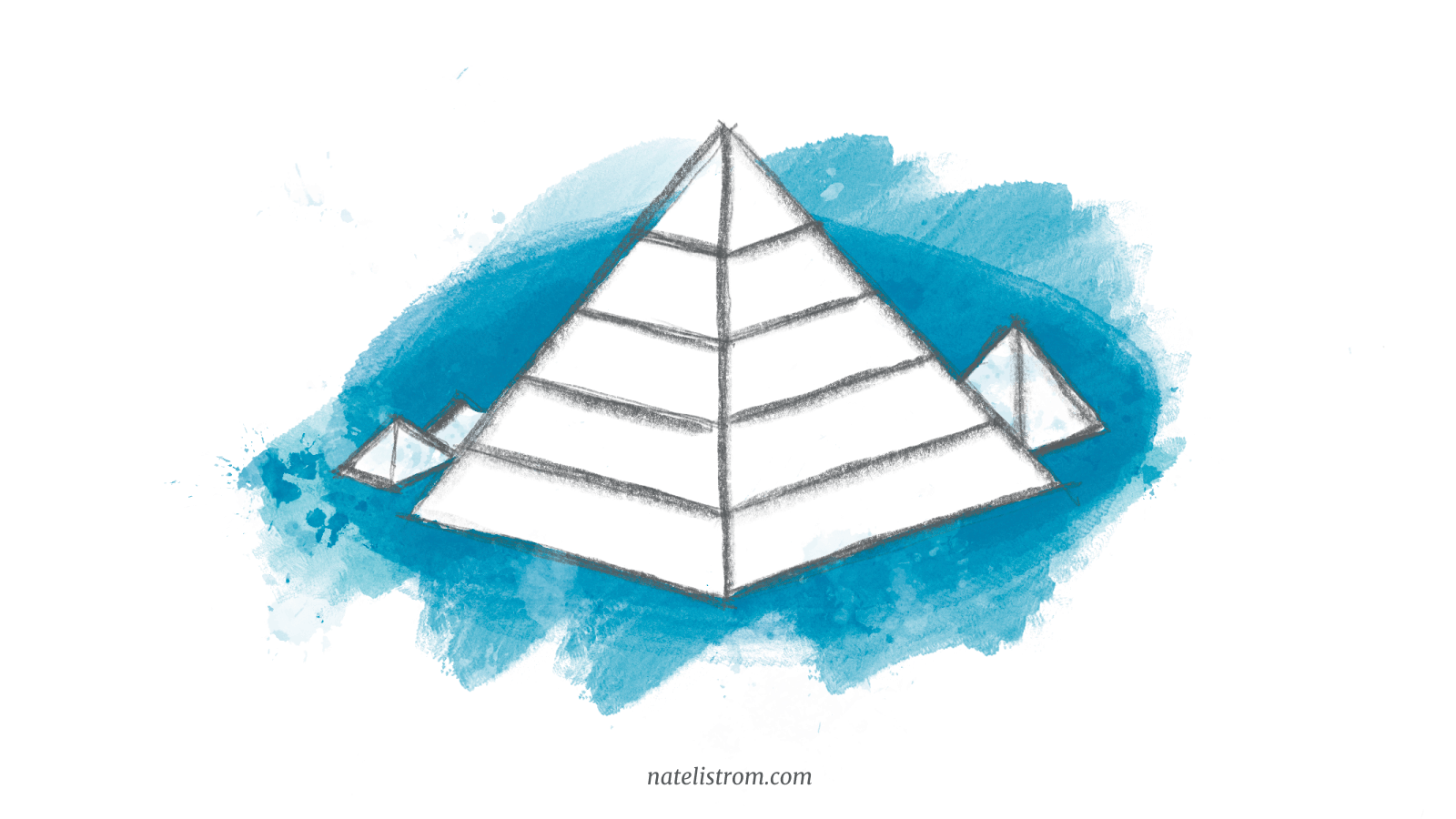
For my own personal benefit over the past several years, I’ve been trying to articulate a systematic theory of story. I don’t think I’ve got it yet, but I’ve found it helpful to think about story experience in terms of five layers. A story that “works” is clear, believable, engaging, affecting, and meaningful.
In my mind, these are similar to Maslow’s hierarchy of needs. The difference is that instead of being about a fulfilling life, these elements contribute to a satisfying story.
Clear
If you want to be clear, you must be aware of the conventions of language. That doesn’t mean you have to follow all the grammar rules exactly. It just means you need to align closely enough that your audience can understand what you’re saying on a basic, mechanical level.
Human minds work from patterns. You should know your language’s patterns, and you should be intentional about how you use them and when you choose to break them.
Beyond that, you must remember that if something isn’t “on the page,” from your audience’s perspective, it doesn’t exist. Your payoff won’t work if the setup lives in your mind but not in the draft.
In the design world, we talk about the curse of knowledge. It’s the idea that once someone becomes an expert in a domain, it becomes impossible for them to approach their field with beginners’ eyes. Likewise, it’s impossible for us to see our stories from an outsider’s perspective. So you may want to enlist others to help you find the gaps.
It’s perfectly fine to be unclear for effect. But be sure your audience knows that’s what you’re doing. There’s a difference between using a bitter flavor to enhance a meal versus accidentally making the food bitter because you added spices at the wrong time. An accomplished chef knows how to manage perceptions so dinner guests understand the intent.
Believable
We live in a world with natural laws of physics and accepted social conventions. Your audience members’ pattern-recognizing brains expect your story world to follow them. If you reject those laws and conventions, your audience’s brains will reject your story.
. . . That is, unless you’ve prepared them ahead of time.
If you told me that a seventeen-year-old boy could out-maneuver seasoned fighter pilots and tap into mystical energy to destroy a military base in a single shot, I’d laugh at you. But it works in Star Wars because we’ve already been given the pieces. Luke has developed his talent as a pilot by flying in Beggar’s Canyon on Tatooine, the Death Star has a weakness that can cause a chain reaction, the Force is a spiritual power that guides all.
Many of the greatest works of fiction make outlandish things seem perfectly reasonable simply because they have been properly set up.
As with clarity, you can break this rule for effect. You can probably get away with one significant thing that appears out of the blue. But it’s risky. And the danger increases the later in your story it happens. Even if you pull it off, it may limit the replayability of your story. Be careful.
As Pixar story artist Emma Coats cautioned in her 22 rules, “Coincidences to get characters into trouble are great; coincidences to get them out of it are cheating.” (Price)
Believability is born in setup. Don’t cheat.
Engaging
To be engaging, you need to work with the human brain’s reward systems. Develop at least a basic ability to raise interesting questions. Tickle your audience members’ desire for an answer. Create uncertainty that demands a resolution.
Give your characters compelling, concrete goals and then set up obstacles that clearly and imminently threaten their ability to achieve those goals. Create problems that your audience expects you to solve. Then deliver solutions in ways that both meet and exceed those expectations.
But don’t answer too quickly. Let things play out a bit. Tease your audience with tension. They’ll thank you for this privately even while they curse you out loud. Anticipation is, itself, an indispensable part of a good meal, a vacation at a tropical beach, a romantic evening.
Karel Segers was right to point out, “When a character asks a question, the worst next step is to answer it.” (Segers)
Layer your questions. Create a new problem before you resolve an old one. And do that over and over and over across the whole length of your story. Always give your audience something to look forward to if they just read the next chapter, watch the next episode, listen for one more minute . . . .
But keep things in balance. Vary the urgency. Not every moment can have (or should have) thriller pacing. Different stories require different levels of drive. There’s room in this world for both Mission: Impossible and To Kill a Mockingbird.
Affecting
The majority of the information a story communicates does not come through logical proof or didactic statement. Instead, stories speak through senses, feelings, emotions, and experiences.
It’s what your audience comes hungry for, and it’s what your story must deliver. Clarity, believability, and engagement — everything we’ve talked about so far — is really in service of this greater, more important goal.
Writing affecting stories is about using specific, concrete details. It’s about the build and release of tension. It’s about wish-fulfillment and peak experiences. It’s about taking moments of deep emotion from your own life and then (quite vulnerably) putting your characters in situations that elicit that same emotional truth. (Grahl)
Your story is not about your protagonist. It’s about your audience. (Hall, Page 126) Your protagonist’s amazing feats of daring, witty verbal banter, pulse-pounding escapes, impossible dilemmas, astounding discoveries, and heart-rending catharsis only matter because in living them, they share those experiences with the people who read or watch or listen.
Your audience wants to feel, so put them “on the hill” and keep them there.
Meaningful
Popcorn and cotton candy are fine as treats, but to grow healthy, our bodies need protein and iron and vitamins. So also, while affect makes a story satisfying on the level of pure entertainment, to be truly significant, a story should deliver more. A good story fills you like a meal.
The stories that endure do so because they resonate with deeply-held values. They tell us something about life, about each other, about ourselves.
That’s a high and weighty responsibility. You must bear it well.
How do you communicate meaning? In terms of mechanics, it’s astonishingly simple. You simply juxtapose two or more elements and allow your audience to infer the relationship. Comparison creates meaning.
“A slap followed by a scream might seem as if someone were crying out because of hit. A scream followed by a slap, however, might seem as if someone was hysterical and hit to bring him to his senses. The order in which events occur changes their . . . meaning.” (Phillips, Loc 1783) (Emphasis mine.)
This plays out across all levels of story. You do it through your high-level plot structure. You do it on a scene-by-scene basis. You do it in your jokes and your exposition and your subtext in dialog. You do it with symbols and irony.
Comparison is everywhere, and everywhere it declares meaning.
Much of the work of revision, once you have built clarity, comes down to aligning all those comparisons, making sure that the gaps are “singing in harmony,” that the story theme is coherent and whole and without distraction.
If you can do that, your story can have profound impact. Maybe not for millions. But certainly for some, a few, a specific one. And to me, at least, that seems a noble and worthwhile aim.
Finally, a caution: Don’t force it. There are few things worse than a tacked-on moral or preachy monologue that “explains it all.” That won’t work. It’s through experience, not education, that information walks down the long aisle from the head to the heart. Meaning must emerge organically from the grist of the story itself.
It must be part of the grain.
In this series so far, we’ve talked about story as a material, a bit about how story’s properties inform its uses, and (in this note) the experience your audience receives from the material.
In the fourth and final note, we’ll turn our attention to how the material nature of story affects process for makers of stories.
Until then: Onward!
Rate this note
Read this next
Work with the grain
To improve your story crafting process, learn what works for you, get help from experts, seek good sources of feedback, and set realistic expectations.
Level-up your storytelling
Understand how stories work. Spend less time wrangling your stories into shape and more time writing them.