Work with the grain
Summary: To improve your story crafting process, learn what works for you, get help from experts, seek good sources of feedback, and set realistic expectations.
Previously in this series, we’ve looked at how story is a material for the mind, how story’s material constraints influence how you can use it, and how story’s properties affect your audience’s experience. In this fourth and final note, we'll look at how story’s properties as a material impact how you work with it as a creator of stories.
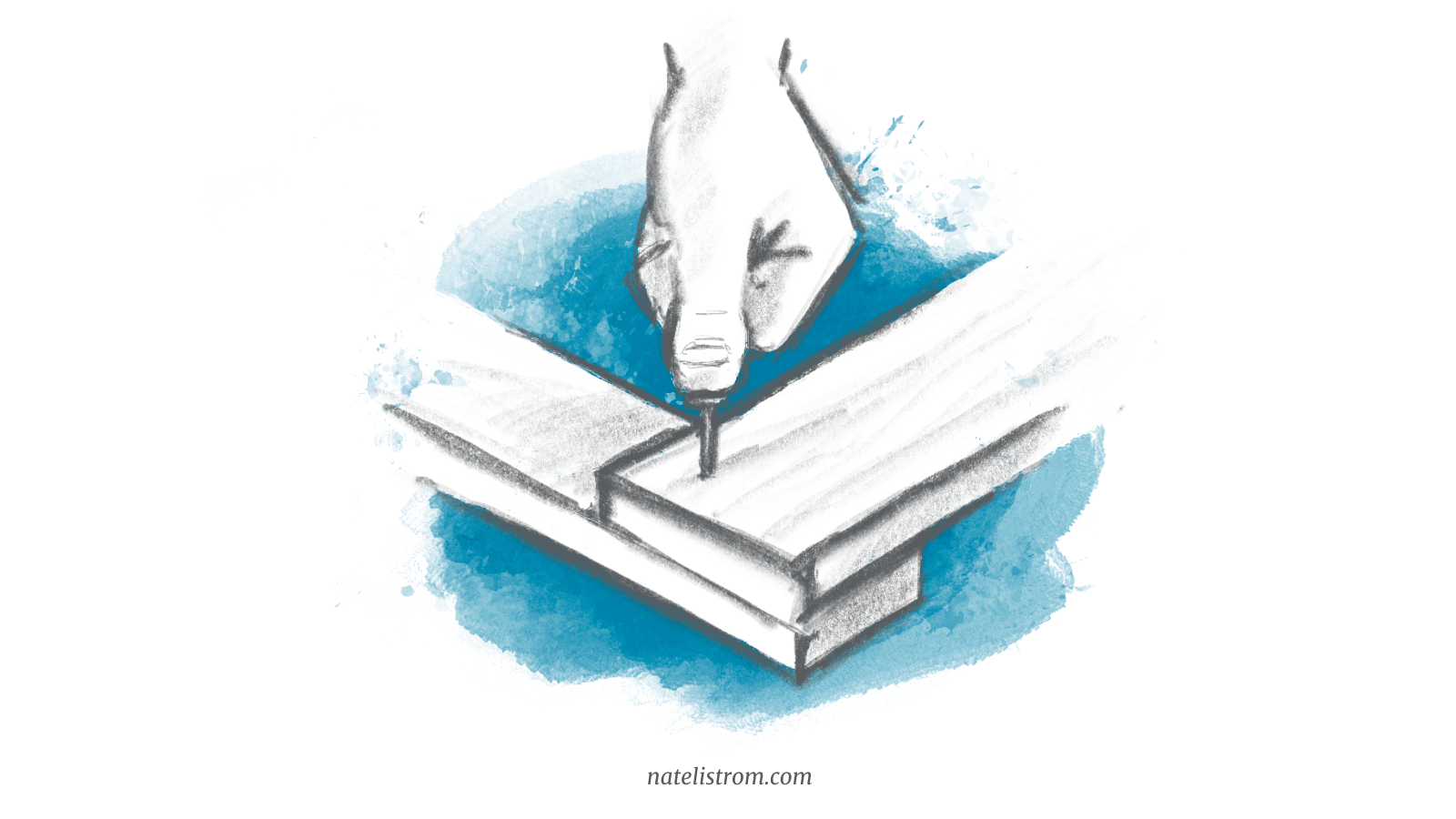
Anyone who’s done much woodworking understands that if you need to drive in a screw near the end of a board, especially with certain types of wood, you must first drill a pilot hole. Otherwise, when the screw goes in, the wood will split. The grain of the wood imposes constraints on the carpenter.
With stories, it’s no different. Story’s properties affect your process.
Before we go on, a quick caveat. Process is an entire world unto itself. Many, who are far more qualified than I, have written entire books about it. A
What I’ll give you here is not the authoritative compendium on process but rather a loose sketch: a few collected thoughts that resonate with my own tiny bit of experience.
Find your grain
First, if story is a material for the mind, one of the minds you must consider is your own.
Plotting versus pantsing; starting with the payoff and then figuring out how to lay the foundation versus starting at the beginning and writing your way through; revising as you go versus speedrunning the first draft; starting from an image, a character, a scene, an emotion, a question, a theme — all these reflect the way different storytellers’ minds work.
No two storytellers’ processes are exactly the same. In fact, accomplished writers even admit that sometimes process differs from one project to the next. (Author Dan Wells on the Writing Excuses podcast: “[My writing process is] different every frigging time. It drives me up the wall. Part of that is because I personally am consciously always trying to do something different with every book. A new genre, or a new style, or a new point of view or something like that.”) (Drake) You should never feel beholden to do things a certain way just because someone else does — even if that someone was you on a previous project.
Sometimes, feedback or advice will immediately make sense. Other times, you’ll try a suggestion and it will feel forced and foreign. That’s okay. You don’t have to listen to everything. Keep trying different things. Experiment.
Eventually, you’ll find your groove.
Learn from experts
While it’s true that you must find your own process, don’t use that as an excuse to ignore solid craft advice. B
Tools are useful. Some approaches are objectively better, even if they feel unnatural at first. You’d be a fool to stubbornly keep trying to drive in nails with your bare hands after someone offers you a hammer.
When I started working with ceramics, my instructors showed me how to remove air bubbles in the raw clay by kneading it like bread dough. This is a process called “wedging.” Wedging is important because, when you fire clay, the heat of the kiln will cause any trapped air to expand creating something like a little, molten balloon. If the air doesn’t have a proper way out, the balloon can burst violently. That may damage both the offending vessel and also anything else nearby.
Wedging is the first step in the process, but its effect doesn’t become evident until the end. It would be very difficult for a learner to discover this technique purely by trial and error. You benefit from having someone tell you about it.
Good teachers offer you this kind of insight. They compress months or years of experimentation, sparing you the toil and pain of producing that knowledge on your own.
Cultivate a good feedback loop
When you make a mistake with clay, the response is quick and — often — catastrophic. A wet pot collapses, a leather-hard bowl splits, a vase warps and shatters in firing. You must start again.
Stories don’t have that inherent feedback loop. It’s an unfortunate constraint of the material. If you want to, you can work on a story for months or years — essentially indefinitely — before you get feedback.
Sure, there are some things you’ll notice yourself. A character action feels off. A phrase needs refining. A section of dialog seems a bit long-winded.
But your brain will also happily fill in gaps for you and smooth over rough edges. It’s our old friend, the curse of knowledge.
You are an expert in your story. You know it intimately. You’re blind to how it appears to someone who’s never heard or seen or read it before.
Because story is a material for communication, you can’t know if it’s working until you have a receiver for that communication. You must share it with someone. Only with feedback from a fresh audience can you discover where things flow and where there are still problems.
A caution here: the quality of the feedback matters. All too many storytellers have discovered the hard way that there’s a difference between people who can merely tell you something’s not working and people who can help you correctly identify what exactly about it isn’t working and construct a solution. It’s an entire aptitude on its own learning to assess and filter bad feedback from good.
Your friend may be able tell you that a pot you made is ugly. Your teacher, who knows material and form and function, can tell you why it’s ugly . . . and what to do to make your next pot better.
The road ahead
As with many creative endeavors, crafting a good story takes time. There’s an initial spark, a period of gathering notes and ideas, a phase of creating a first complete version, and a season (sometimes more than one) of iterating and refining. New sparks and ideas and notes will come along the way. It’s a spiral of refinement.
When you’re just learning the material, it can be tempting to think that you’re near the finish line at each major milestone. But the wet clay needs to dry. The dry clay needs to be fired. The fired clay needs to be glazed and fired again . . .
I don’t say this to discourage you but to help you manage your expectations. A finished first draft of a novel is a monumental achievement. But in most cases, it’s still less than half way through the process.
The material needs time to develop.
Thank you so much for joining me on this little exploration of story as a material.
I hope these ideas have been as enjoyable for you think about as they have been for me to write. Perhaps you’ve even been inspired with some ideas of your own. If so, I’d love to hear about them and maybe see you publish them somewhere.
And, if we’re both very fortunate indeed, it’s hopefully equipped you with one or two things you can use occasionally when you sit down to your craft.
It’s to that end that I now say: onward!
Change log
April 11, 2026 - Updated clay wedging section to use the metaphor of a molten balloon.
Rate this note
Level-up your storytelling
Understand how stories work. Spend less time wrangling your stories into shape and more time writing them.